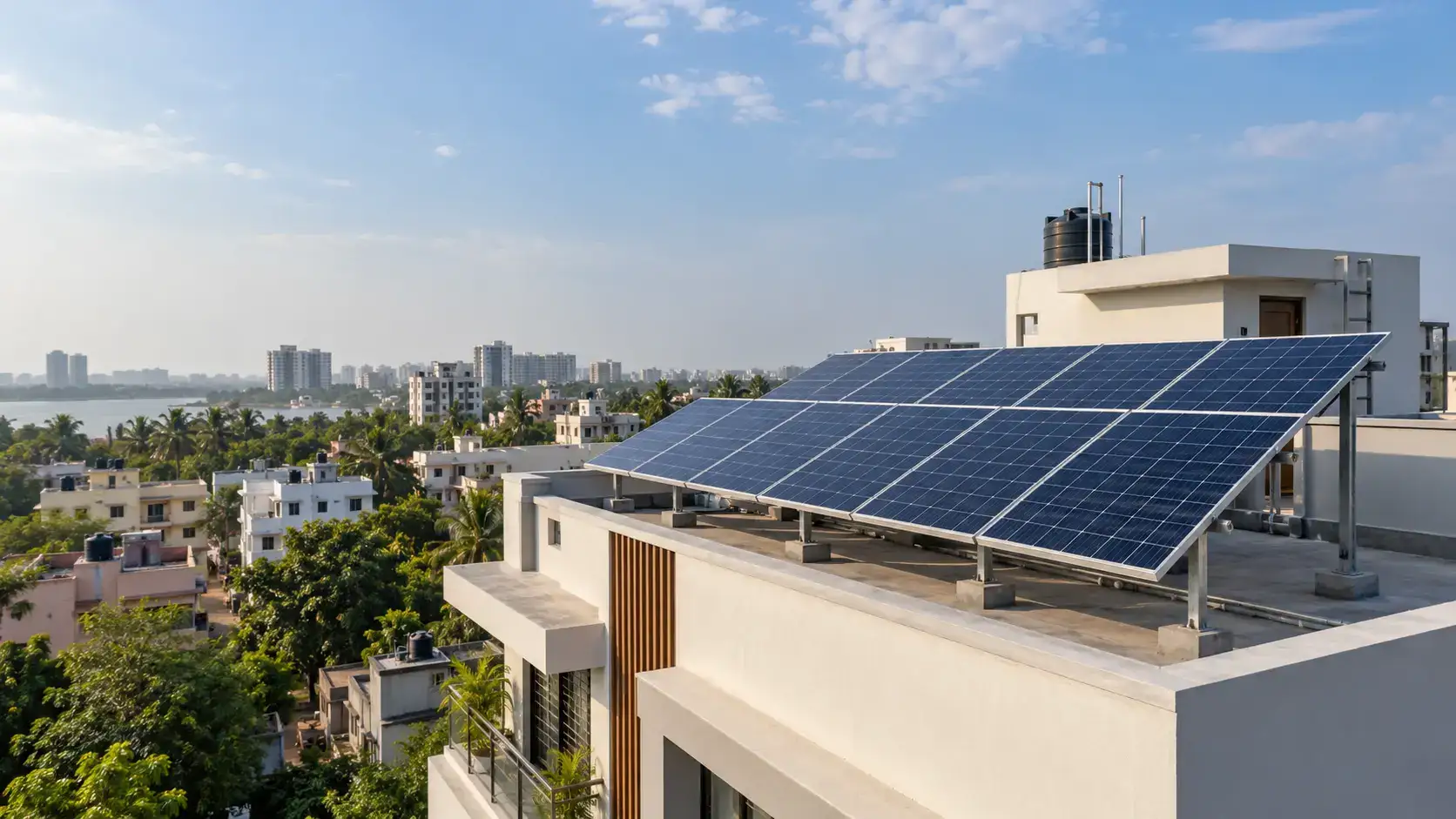
Rooftop Solar for Your Home
Sized around your electricity bill, your roof and how your household actually uses power — not a generic package.
Start With the Bill, Not the Brochure
Most homeowners come to solar because of the electricity bill, not because of a cause — and that's a perfectly good reason. A system that's sized against your actual monthly consumption, rather than the biggest one that fits your roof, is usually the more sensible one financially.
- Your recent bills are the starting point for sizing, not a sales target.
- Roof condition, shading and structure are checked before any number is finalised.
- Net-metering and subsidy paperwork is explained for your specific DISCOM and address.
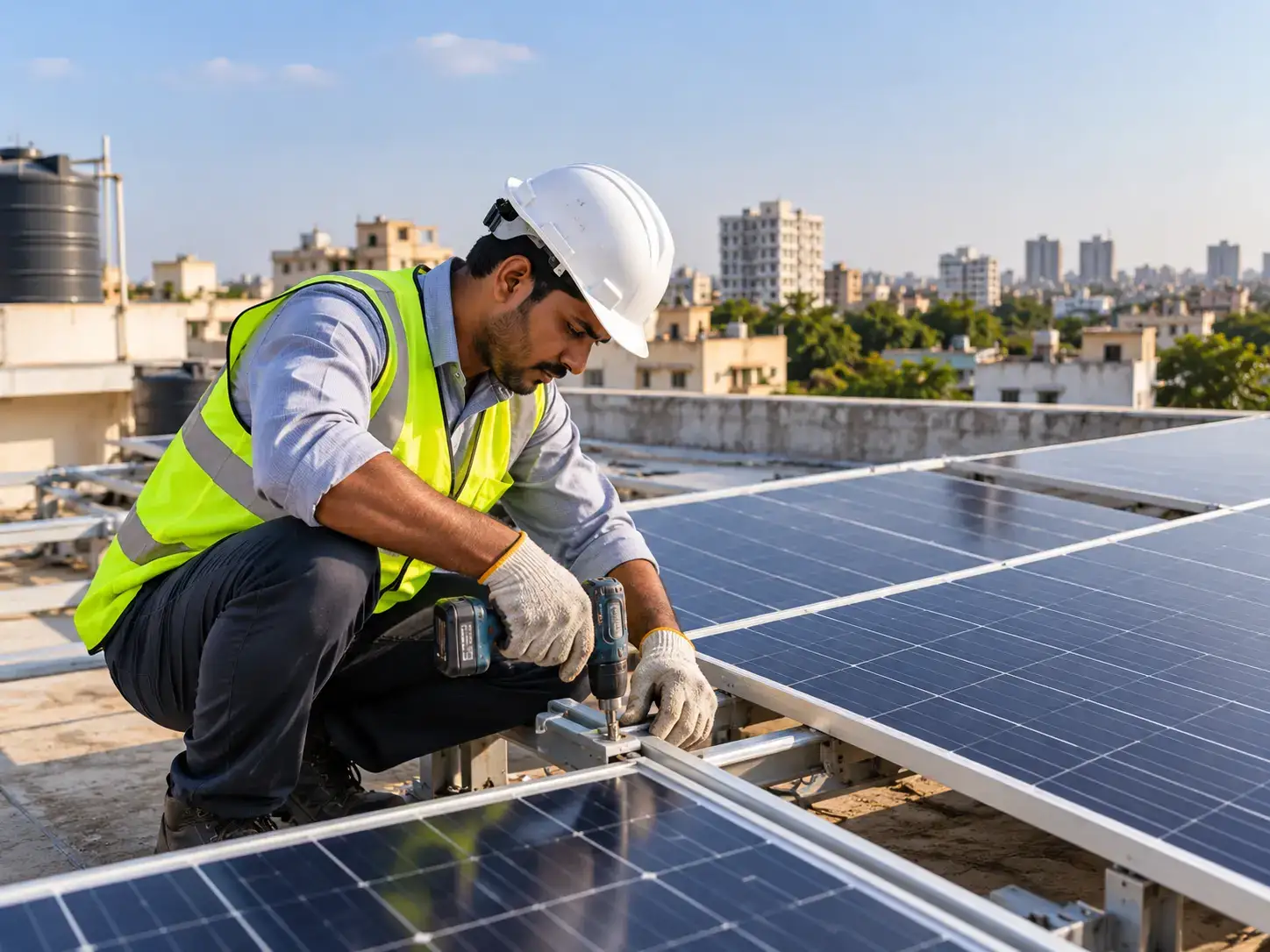
How Much Roof Does It Need?
A flat RCC roof and a metal shed roof carry panels differently — here's the general pattern.
Flat RCC roof
90–110 sq ft / kW
Illustrative — confirmed at site assessment.
Metal shed roof
70–85 sq ft / kW
Illustrative — confirmed at site assessment.
What System Size Fits a Home?
Most homes land somewhere between 2 kW and 8 kW. Try a few sizes to get a feel for the roof space involved.
9 panels illustrated, assuming a 550 Wp panel
9
Illustrative panel count
350–550
Sq ft of roof, illustrative
Typical range for a home or small shop
Illustrative only — actual panel count, layout and roof area depend on your specific panel model, roof shape and shading, confirmed at site assessment.
Common Residential Questions
Will solar work during a power cut?
Not by default. Standard grid-tied solar systems are required to switch off automatically during a grid outage, for the safety of linemen working on the network. If backup power during outages matters to you, that needs a hybrid inverter and battery, which is a separate design decision with its own cost.
How much roof space do I need?
It depends on system size and roof type. Flat RCC roofs generally need more area per kW than a metal shed roof, because tilted mounting on a flat roof needs row-to-row spacing to avoid shading. Our solar calculator gives an indicative area range from your inputs — the exact figure is confirmed at site assessment.
How do I know what system size I need?
Start from your electricity consumption (your bill is a reasonable proxy), then check it against available roof area and how your usage is spread through the day. Our quick estimator gives a starting range; the confirmed size comes from reviewing your actual bill, connection type and roof during assessment.
Can solar work on an apartment building?
Often yes, but it needs a few extra conversations upfront: terrace access, resident or society approval, and how the building's electricity is metered (individual flats vs common areas). These vary by building and by DISCOM, so housing societies usually need a slightly longer assessment stage than a standalone home.
What happens during monsoon?
Rooftop systems are engineered for outdoor conditions year-round, with appropriate mounting, cable routing and earthing for monsoon weather. Heavy, sustained cloud cover will naturally reduce output on a given day, the way it reduces daylight generally, but the system keeps operating. Structural and drainage considerations for your specific roof are part of assessment.
What maintenance is required?
In general: periodic cleaning to clear dust and debris from panels, and occasional visual and electrical checks. How often depends on your local dust levels, roof access and the equipment installed. We set out a maintenance approach as part of the proposal, specific to your system.
Is a battery required?
No. Most residential and commercial rooftop systems in India are grid-tied without a battery — excess generation is exported to the grid and adjusted through net metering. A battery is an optional add-on if backup for specific loads during outages matters to you, and it changes both the cost and the system design.
How does net metering work?
A bidirectional meter records how much power you export to the grid and how much you import from it, and your bill is settled on the net figure over the billing cycle. The exact application steps, meter type and timelines are set by your local electricity distribution company (DISCOM) and can differ by state — we confirm what applies to your address during assessment.
Ready to see what your roof can do?
Start with a short assessment request — no sales commitment.